Quantum-Meme Cryptography
What is quantum cryptography and why should you care?

An important part of this magic is that it's secure. Even if someone listens to this communication, they would not be able to read your message. Instead, what they see is a large chunk of encrypted information that they can’t read. To be able to read this, they need a special key, one that only you and your friend have. This works for now, sending and receiving messages where only the two ends have the right keys to access the data.
There is one problem: quantum computers!
You have probably heard that they are very fast. In fact, recently, Google solved a task that would have taken 10,000 years to complete on their fastest computer in about 200 seconds. Now let's get back to our two keys. Yes, quantum computers can try keys very, very fast. Think of having a keyholder with all the possible keys in the world, given the time you will open any lock. And quantum computers happen to be able to try many different keys at once.

Introduction to quantum computing
One of the basics of Classical computers is that it's basic unit of data - bits- can exist in one of two states simultaneously. It could be a '0' or a '1'. Compared to classical computers, Quantum computers use some of the principles of quantum mechanics.
Two concepts in quantum mechanics that are related to Quantum computing are:
1. Superposition
2. Entanglement.
Superposition allows particles to exist in multiple states at once. We know that in classical computing, 'bits,' can either be in one of two states - 0 or 1. However, when it comes to quantum computing, we use 'qubits,' where this basic unit of data can exist in more than 1 state simultaneously. An implication of this is that it exponentially increases the speed of computations when compared to classical computers.

This also helps in performing complex calculations more efficiently than classical computers.
We already established that quantum computers use ‘qubits’ instead of ‘bits,’ and that gave them an edge over classical computers in both speed and efficiency. The ability to exist in different states simultaneously creates the ability for quantum computers to handle exponentially more information at once. This can potentially be used to revolutionize industries like financial modeling, mathematics, particle physics, and many other fields that may require systems to deal with large amounts of data. This potential expands further when it’s integrated with already existing systems like the supercomputers (quantum accelerated supercomputing).
It sounds all good and nice until we consider not just the positive influence but also the negative. A major field where this might influence negatively is traditional cryptography. Currently, many encryption algorithms rely on the difficulty of factoring large numbers into primes. That is because factoring large numbers may require an exhaustive search of numbers, whose process might take an exponential amount of time. This exponential cost can be offset by quantum computing, and this threatens the security of systems. It can potentially break much of the encryption that currently secures our digital computations.
How quantum computing relates to cryptography
Quantum computing poses a significant threat to traditional cryptography because of its ability to solve certain mathematical problems much more efficiently than classical computers. One such problem is integer factorization, which forms the basis of widely used encryption methods like RSA.
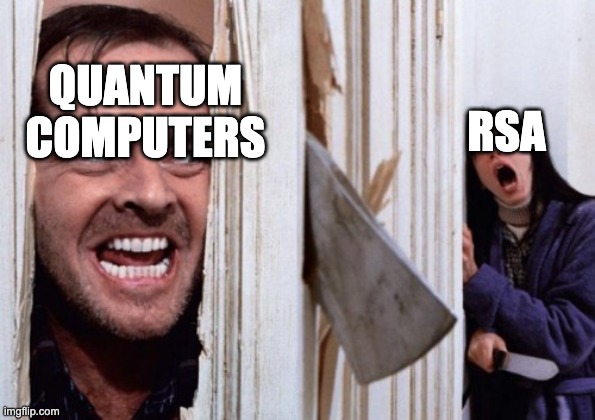
To put things simply, encryption is like a lock, and for the lock, you need a key. For example, if you have a 4-digit PIN code as a key, you need to go through all possible combinations to guarantee that you will open it without knowing the key.

4-digit is not that bad. It will probably take some time to go through all the options since there are 10000 combinations, but it is something a human is capable of doing manually, even though it will take many hours. But if you double the number of digits, it will be 2.82 trillion. Even though there is a theoretical way of finding all combinations for 8-digit code in practice for human beings, it is impossible due to the amount of time it will require.

Encryption is based on mathematical problems that are challenging for a computer and will take an extremely long time to solve, which makes hacking the encryption and coming up with a solution to it quickly impossible. But quantum computing significantly expands the number of problems that can be solved practically in a reasonable time.
For example already mentioned RSA, relies on the difficulty of factoring large composite numbers into their prime factors. Classical computers struggle with this problem when the numbers involved are sufficiently large, making RSA encryption secure. However, quantum computers, specifically through algorithms like Shor's algorithm, have the potential to efficiently factor large numbers, rendering RSA and other similar encryption methods vulnerable.

The same goes for elliptic curve cryptography (ECC), which is widely used in applications like digital signatures and key exchange protocols.
However, encryption algorithms are not vulnerable to quantum attacks. Some encryption methods, such as symmetric-key cryptography based on algorithms like AES (Advanced Encryption Standard), are considered to be relatively resistant to quantum attacks.

How breaking cryptography is countered by quantum cryptography
“Math may not help you, but Physics will.”

Now that we’ve established that RSA could be decrypted with faster and better computers, such as quantum computers, we need a better way to hide our information. This is where physics can help us.
Instead of deciding on a large factor before communication, each is randomly decided by the sender, and the recipient must receive the same key to unlock the message. For this to happen, we leverage the power of photons.

Say that we want Alice and Bob to communicate discreetly over a channel about their upcoming CS142 assignment. They want their channels private since Minerva’s policy strongly discourages copying assignments. Alice sends Bob a stream of photons, all polarized in a randomly predetermined way. They are polarized/vibrating in four different directions: horizontal, vertical, left diagonal, or right diagonal.
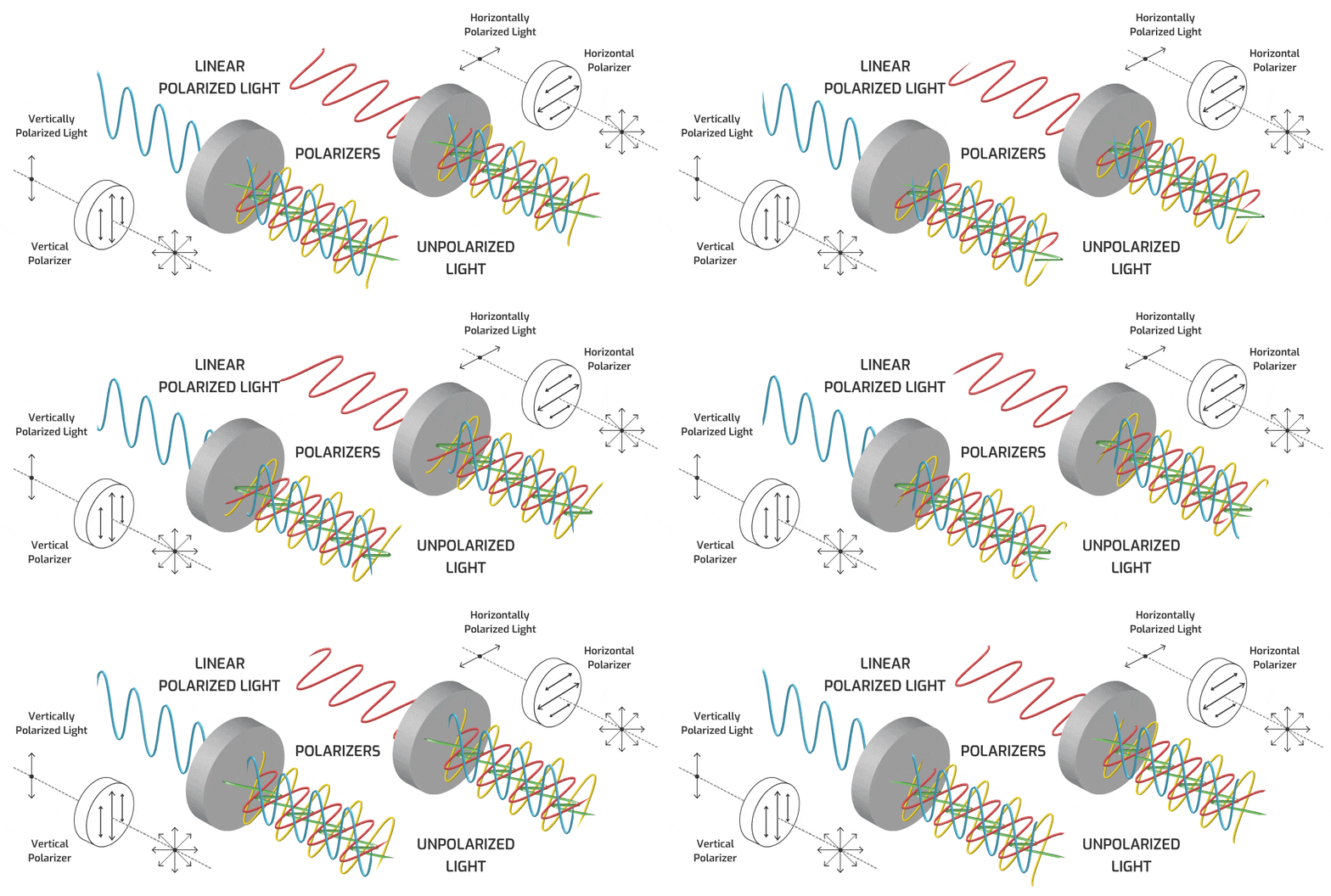
Now, it's Bob’s turn to guess this configuration. Since this is merely the start of this communication, Bob does not know the correct polarization and can only use one of two polarization detectors. With quantum cryptography, he can only guess which to use, randomly selecting one of the two and seeing the direction of vibration. This is then translated to 1s and 0s. For example, one detector can register horizontal vibration as 1 and vertical vibration as 0. After the stream is done, Bob then compares with Alice for each photon and what detector he used. If he used the wrong one, Alice would simply tell him to discard it. After this filtering, what's left is a set of identical keys for both Bob and Alice. After this, messages can be sent normally.

But what if someone peeked?
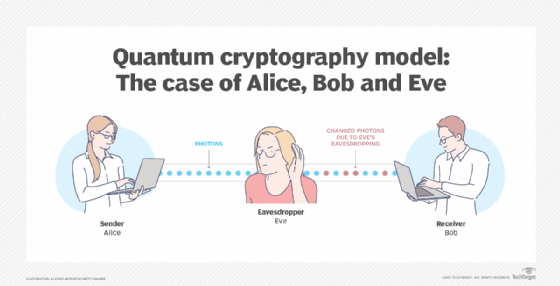

Quantum Cryptography: A Promising Shield, But Not Without Chinks in its Armor
While Quantum Cryptography technology might be a solution to dealing with the threats of quantum computing to encryption, there are challenges and limitations to the technology.
One of such is the cost associated. A dedicated quantum communication network with specialized equipment is expensive, and the integration (for generating, sending, and detecting quantum states is expensive and complex) with existing infrastructure incurs further costs.
Apart from the cost, the distance over which quantum keys can be securely transmitted is limited. This conflicts with the entanglement property, and this limitation is due to the loss of Photons (which carry the quantum information) as they travel through fibers or space.

Also, Quantum Cryptography relies on certain assumptions that may not hold in realistic scenarios, leaving it vulnerable to attacks like side-channel attacks and attacks on the photon detectors. The lack of authentication in Quantum Cryptography protocols also makes them vulnerable to man-in-the-middle attacks. In terms of scalability, Deploying a large-scale Quantum Cryptography network requires a complex infrastructure with a quadratic number of point-to-point links, making it impractical for global-scale adoption.
Comments
Post a Comment